

To build a winning search campaign, you cannot treat SEO as a guessing game. Utilizing competitor keyword analysis allows us to peek at our rivals' search strategies, evaluate their organic visibility, and map out their target audience. Instead of spending months experimenting with unproven topics, we inspect existing Google search engine results pages (SERPs) to construct a strategic blueprint.
A thorough analysis relies on three core pillars: domain authority, search intent, and structural topic coverage. If you want to dive deeper into how competitor research connects with overarching digital marketing workflows, explore our curated resources.
When conducting an audit, keep in mind that bigger competitor domains naturally rank for an exponentially higher volume of total keywords than smaller niche sites. To conduct a thorough audit without getting overwhelmed, we must establish a repeatable framework to analyze their rankings:
- SERP Evaluation: Inspecting who currently holds page-one positions for core category terms.
- Search Intent Classification: Distinguishing whether users want to buy, learn, or compare options.
- Domain Authority Calibration: Comparing your site's credibility against rivals to ensure you target realistic search terms.
- Gap Identification: Locating high-value topics your competitors cover that are missing from your site.
As detailed in Moz's guide on How to Conduct a Competitor Keyword Analysis, uncovering valuable search terms is not about chasing every query under the sun. It is about identifying keywords where competitors hold strong rankings that you can match or exceed with superior content.
How to Identify Direct SEO Competitors Using Competitor Keyword Analysis
Your real-world business competitors are not always your direct SEO competitors. A local store down the street might be your primary market rival, but online, you could be competing against industry blogs, multi-location directories, or massive nationwide e-commerce platforms.
To find your true SERP rivals, start by identifying 5 to 10 seed keywords that describe your core products or services. Input these terms into search engines or keyword tools to reveal which domains consistently claim organic footprint on page one.
When evaluating audience overlap, focus on sites that share your target market's intent. If an established competitor ranks for 124k keywords while a large retailer boasts 5.3M estimated monthly visits, do not let those massive numbers intimidate you. By narrowing your focus to local, high-intent seed terms, you can extract the precise domain footprint driving relevant traffic to those sites.
Executing a High-Yield Keyword Gap Analysis
A keyword gap analysis compares your domain against up to 5 or 10 search rivals to reveal unranked terms and clear topic gaps. Instead of creating content blindly, you leverage a list of proven topics where multiple competitors are already winning traffic.
To run an effective gap analysis, follow these essential steps:

- Select Baseline and Target Domains: Input your domain alongside 3 to 5 primary niche competitors.
- Filter Out Unranked Terms: Isolate search queries where multiple competitors rank in positions 1–20, but your domain does not rank at all.
- Group Shared Keywords: Identify terms shared by multiple competitors. If three distinct rivals all rank on page one for a term, that signals verified market demand and search relevance.
- Evaluate Search Metrics: Analyze search volume, Keyword Difficulty (KD), and Cost Per Click (CPC) to choose your top content opportunities.
Using specialized utilities like this Keyword Gap Analysis Tool allows you to quickly filter domain gaps by volume and ranking position. Focusing on keywords where multiple competitors hold top positions gives you an instant shortcut to proven content opportunities.
Top Tool Capabilities to Evaluate for Competitor Keyword Research
When selecting software platforms for competitor keyword analysis, marketing teams must look beyond basic search volume metrics. Modern platforms maintain massive databases—some indexing over 200 million keywords across 258 million domains—giving you real-time visibility into complex search landscapes.
Key features to look for in competitive research tools include:
- Geographic and Local SERP Coverage: Search trends change significantly based on location. Ensure your platform supports country-level filtering across dozens of countries, as well as local SERPs across 50,000+ specific cities or regions.
- Database Scale: Large databases ensure long-tail niche keywords and localized search variants are accurately captured.
- Real-Time Rank Tracking: Daily or weekly ranking updates help you react quickly when competitors publish new pages or shift tactics.
- Paid Advertising Intelligence: Understanding paid search budgets and Cost Per Click (CPC) data reveals which terms hold actual commercial value.
| Capability | Organic Keyword Analysis | Paid Keyword (PPC) Analysis |
|---|---|---|
| Primary Metric | Keyword Difficulty (KD), Organic Positions | Cost Per Click (CPC), Ad Rank Position |
| Data Goal | Find content gaps and topic opportunities | Uncover high-intent, converting keywords |
| Strategy Focus | Building domain authority & long-term traffic | Immediate lead generation & seasonal capture |
| Tool Benchmark | Search Volume, Position 1-20 filtering | Ad Copy examples, Estimated Ad Spend |
For teams exploring specialized advertising intelligence, leveraging resources like this Free AdWords Competitor Analysis Tool helps you review rival PPC campaigns, ad copy variations, and historical spend.
Core Metrics for Evaluating Organic Ranking Data
Once your tool returns thousands of keyword rows, you need a system to evaluate raw ranking data. Relying on search volume alone is a major mistake; you must weigh volume against keyword difficulty and search intent.
- Keyword Difficulty (KD): Measured on a 1–100 scale. Newer websites lacking domain authority should focus on long-tail keywords in the 1–40 KD range. Established domains can comfortably target 50–70 KD terms.
- Monthly Search Volume: The estimated number of monthly searches. A competitor ranking #1 for a 500-search term drives far more business value than sitting at #30 for a 5,000-volume term.
- Search Intent: Is the user seeking information, looking for a specific website, or ready to make a purchase?
- Estimated Organic Traffic: A metric calculated using ranking position and expected click-through rate (CTR).
Uncovering Paid Search Tactics with Competitor Keyword Analysis
Evaluating your rivals' paid search spend reveals their top-converting keywords. Businesses do not spend money on ad clicks unless those searches generate revenue.
If a competitor pays $25+ per click for terms like 'enterprise software' or specialized legal services, that high CPC signals strong commercial intent and high conversion rates. Conversely, long-tail terms with $2–$3 CPCs offer cost-effective options for steady lead generation.
By using tools like this real-time Competitor Keywords Tool, you can review both organic rankings and paid keywords simultaneously. Analyzing rival ad headlines, sitelink extensions, and seasonal ad campaigns helps you refine your marketing strategy and capitalize on high-intent conversion terms.
How to Prioritize and Integrate Competitor Keywords into Your Content Strategy
Once you extract hundreds of competitor keywords, the next step is prioritizing them. Rather than randomly picking terms, organize your data using a Quick Win Matrix.
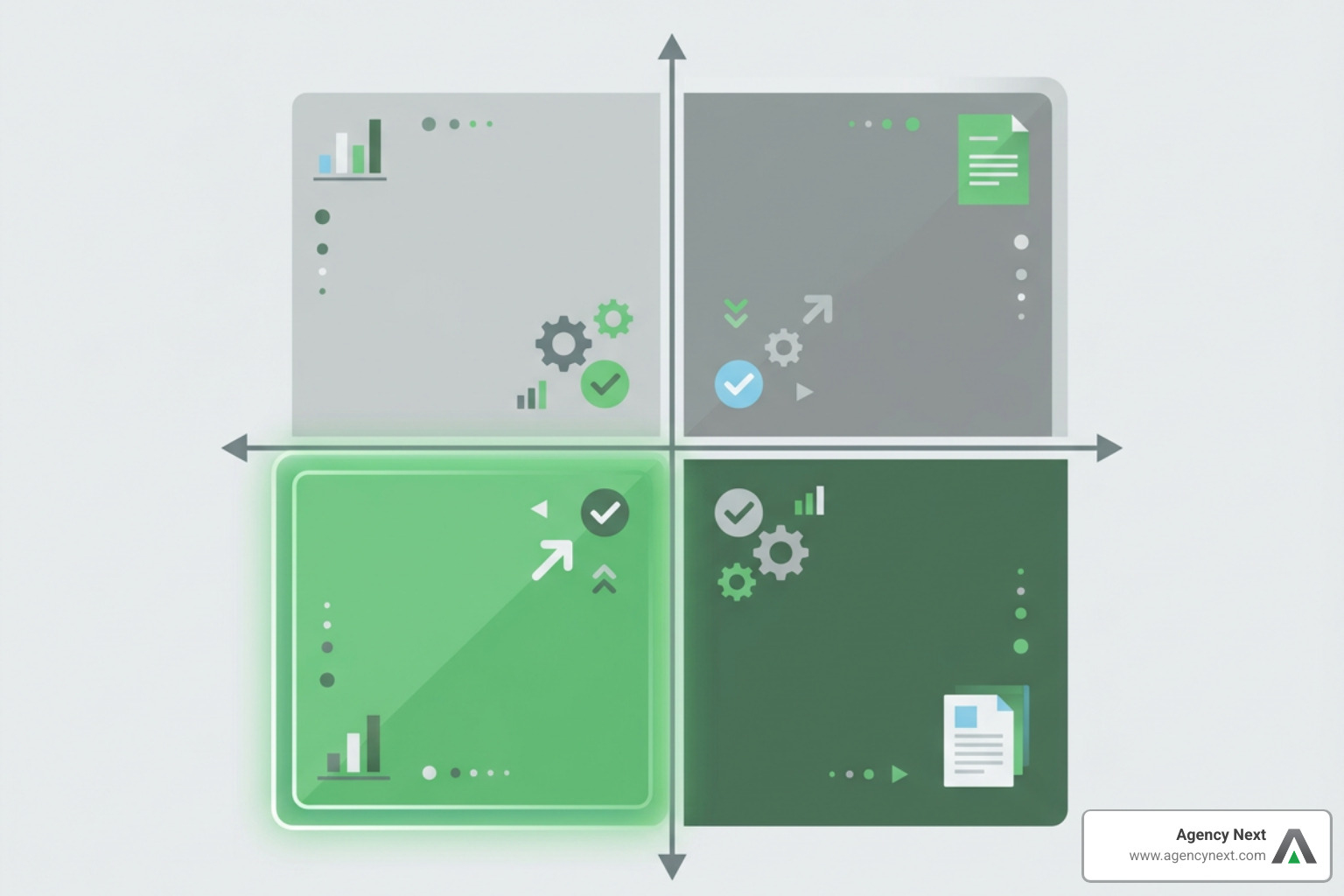
This framework categorizes keyword opportunities into four distinct quadrants:
- Quick Wins (Low Difficulty, Weak Competitor Content): Low competition terms where competitors offer brief, outdated, or poorly structured pages. Target these first for page-one rankings within 3 to 6 months.
- Hidden Gems (High Difficulty, Weak Competitor Content): Highly searched terms where top-ranking pages lack depth, giving you a chance to win with comprehensive content.
- Long-Term Targets (High Difficulty, Strong Competitor Content): Competitive category terms that require substantial domain authority, deep content clusters, and backlinks.
- Low Priority (Low Difficulty, Strong Competitor Content): Terms with low search demand where competitors already maintain authoritative, highly optimized resources.
To avoid creating duplicate content, group your prospective keywords by Parent Topic and search intent. Modern search engines understand synonyms and related queries. Instead of publishing separate articles for "coffee maker guide" and "how to choose a coffee machine," group those terms into a single topic cluster. To see examples of how we structure targeted search campaigns for clients, view Our Work.
For detailed execution workflows on topic clustering and keyword grouping, refer to Ahrefs' instructional guide on How to Find and Use Competitor Keywords.
Reverse-Engineering Competitor Page Layouts and Content Gaps
Identifying top keywords is only half the battle. To outrank a rival, you must understand why Google ranks their page. That requires reverse-engineering their page layouts and auditing their structural on-page elements:
- Meta Titles and H1 Tags: Note how competitors phrase primary keywords and value propositions in their blue search links and main headings.
- Heading Architecture (H2/H3): Map out the subtopics, questions, and secondary keywords covered across top-ranking pages.
- Answered Questions: Identify explicit questions answered on top pages to optimize your content for Google's featured snippets and People Also Ask (PAA) boxes.
- Missing Sections and Layout Gaps: Look for content gaps on rival pages. Do they lack comparison tables, clear calls to action, visual infographics, or step-by-step instructions?
When updating existing articles or building new pages, focus on delivering more complete answers. Offering clearer, better-organized information than existing SERP results is the primary way to earn higher rankings in search engines.
Rank Tracking and Avoiding Common Analysis Pitfalls
Executing a competitor keyword analysis is an ongoing process, not a one-time project. Continuous rank tracking allows you to monitor how your content performs against competitors over time.
To ensure your analysis delivers real ROI, avoid these common SEO mistakes:
- Chasing Vanity Metrics: Do not target high-volume keywords with low commercial relevance just to boast about impressions. A rank #1 position on a 50-volume commercial term drives far more conversions than position #30 on a 5,000-volume generic phrase.
- Obsessing Over Branded Keywords: Filter out competitor brand names from your research exports. Ranking for a rival's specific trade name rarely generates quality leads.
- Ignoring SERP Intent: If top results for a keyword are all e-commerce product pages, publishing an informational blog post will rarely secure a page-one position.
- Failing to Keep Content Fresh: Search engines reward up-to-date resources. Track rank fluctuations and update existing pages whenever competitors release better content.
To see how we apply ongoing tracking and technical SEO adjustments across client projects, explore our Project Archive.
Frequently Asked Questions About Competitor Keyword Analysis
What is keyword gap analysis and how does it help SEO?
A keyword gap analysis is the process of comparing your domain's keyword rankings against a group of direct competitors. It identifies high-value terms, topic coverage gaps, and strategic content opportunities that your rivals rank for but your domain does not.
By filling these gaps, you can build targeted content that captures untapped organic search traffic.
How quickly can you see rankings from competitor keywords?
When companies start their content planning with competitor keyword data rather than guesswork, they often achieve page-one rankings within 3 to 6 months on targeted long-tail terms.
Actual timelines depend on your site's existing domain authority, the keyword difficulty of targeted terms, and how effectively your content satisfies search intent compared to top-ranking competitors.
Should you target every keyword your competitors rank for?
No. Blindly copying every keyword a competitor targets is inefficient and leads to wasted budget.
Focus exclusively on terms that offer strong business relevance, clear commercial intent, and manageable keyword difficulty. Skip competitor brand names, low-intent terms, and competitive terms where your current domain authority cannot realistically compete.
Conclusion
Conducting a strategic competitor keyword analysis replaces guesswork with clear search evidence. By identifying real SERP rivals, running keyword gap analyses, and organizing topics with a Quick Win Matrix, you can build an authoritative content plan that drives predictable traffic growth.
At Agency Next, we help local businesses, brand builders, and professional athletes turn competitive search data into high-converting digital assets. Whether you need custom web design, AI-powered video production, or automated ad management, our team builds growth strategies tailored to your market.
Ready to outrank your digital competitors and drive higher ROI from organic search? Contact us today or explore our full suite of digital marketing services to kickstart your campaign!
Featured Resources
Check Our Latest Resources