

Why Dofollow SEO Backlinks Matter for Rankings
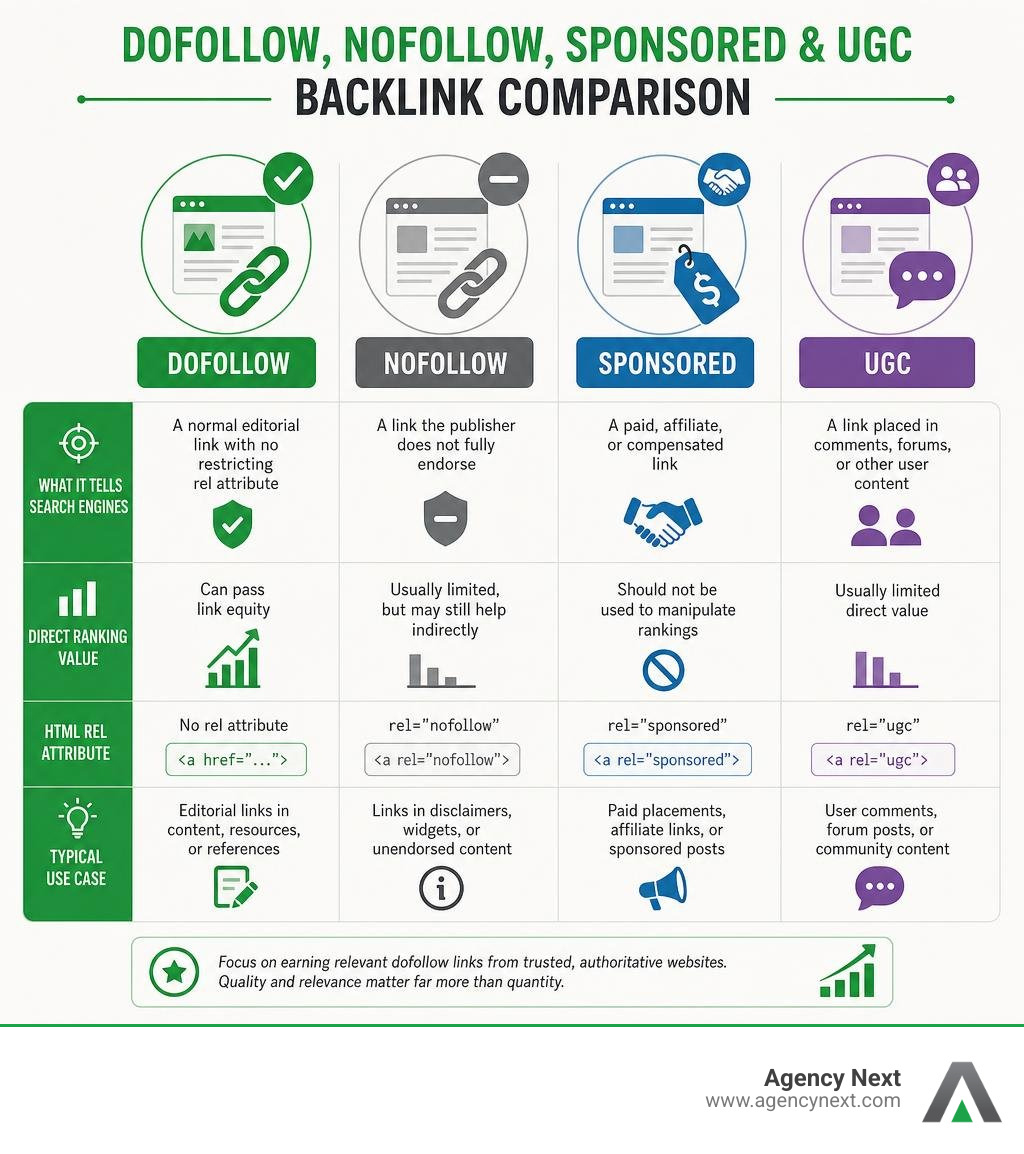
Dofollow SEO backlinks are standard links from another website to yours that can pass ranking signals, often called link equity, to the page they reference. In simple terms, when a trusted, relevant website links to your business in its content, that link can help search engines see your page as more credible.
| Link type | What it tells search engines | Direct ranking value |
|---|---|---|
| Dofollow | A normal editorial link with no restricting rel
attribute |
Can pass link equity |
| Nofollow | A link the publisher does not fully endorse | Usually limited, but may still help indirectly |
| Sponsored | A paid, affiliate, or compensated link | Should not be used to manipulate rankings |
| UGC | A link placed in comments, forums, or other user content | Usually limited direct value |
For a local business, the goal is not to collect the most links. It is to earn real mentions from relevant sites: local organizations, industry publications, suppliers, partners, and trusted community resources. One well-placed editorial link can matter far more than dozens of low-value directory or footer links.
I am Koby Luedtke, Co-Founder of Agency Next, where I help local businesses improve visibility through conversion-focused websites, SEO, and digital strategy. In this guide, I will break down how dofollow SEO backlinks work and how to judge which opportunities are worth your time.
Understanding Dofollow SEO Backlinks and Link Attributes
To understand how links pass value, we must clear up a fundamental web myth: there is actually no such HTML tag as rel="dofollow"
. "Dofollow" is simply industry shorthand used by marketers to describe standard hyperlinks that lack restrictive attributes. When you insert a regular HTML anchor tag like <a href="https://yourdomain.com">Anchor Text</a>
, it is automatically followed by search engine crawlers.
To restrict crawlers, webmasters add specific rel
parameters inside the anchor tag. Understanding these distinctions is critical for modern off-page strategy, especially as search engines have evolved:
- Dofollow (Default HTML): Unmarked links that allow search engines to crawl the destination page freely and transfer PageRank (link equity).
-
rel="nofollow": Introduced back in 2005 to combat blog comment spam. It tells search crawlers not to endorse the linked page. -
rel="sponsored": Rolled out in September 2019 to explicitly categorize paid links, sponsorships, display ads, or affiliate partnerships. -
rel="ugc": Also introduced in 2019, this tag designates User-Generated Content, such as links placed within forum threads, blog comments, or user profiles.
A pivotal shift occurred on March 1, 2020, when search engines shifted from treating rel="nofollow"
as a strict, hard directive to a "ranking hint." Under this hint model, search engines preserve the right to crawl, process, and consider nofollow or UGC links for indexing and discovery based on context. For a deeper technical breakdown of how these attributes differ, read Dofollow vs nofollow links: what is the difference? | Link Inbound.
How Link Equity Flows with Dofollow SEO Backlinks
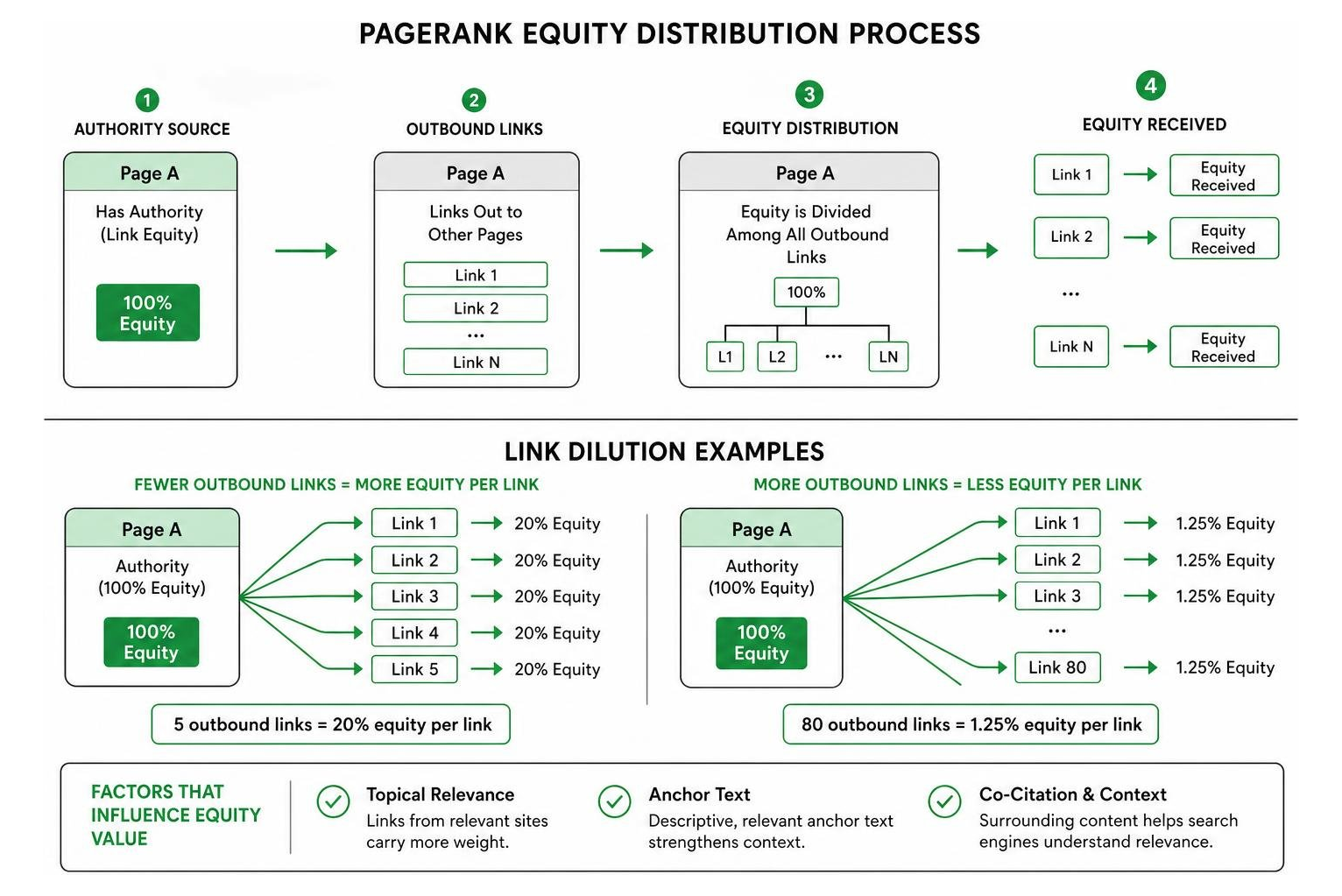
Link equity (historically known as PageRank) does not simply transfer in equal, fixed blocks from site to site. Instead, authority behaves like a fluid dynamic system. When a page earns authority, it distributes that equity across all outbound links present on the page.
Understanding this mechanism highlights several crucial principles about how equity actually passes:
- PageRank Dilution: If a page with moderate authority contains only 5 outbound links, each link receives a significant share of that page's equity. If that same page contains 80 outbound links, the equity passed to each individual destination becomes heavily diluted.
- Topical Relevance Multiplier: A link from a niche-relevant website carries a distinct authority multiplier compared to a link from an unrelated site.
- Co-Citation and Context: Search engines analyze the surrounding text (co-citation environment) and the anchor text itself to determine topic alignment.
- Body vs. Boilerplate Placement: A contextual dofollow seo backlink embedded inside a substantive editorial paragraph passes far more value than a link buried in a site-wide footer or sidebar directory.
To explore how equity calculations function under the hood, check out What Is a Dofollow Link? Why Most Pass Less Than You Think.
How to Verify and Inspect Dofollow SEO Backlinks
Verifying whether a prospective or newly acquired link is truly dofollow is straightforward and requires no paid software. You can audit any DOM element directly in your desktop browser:
- Hover over the link on the webpage.
- Right-click the link and select Inspect(or Inspect Element) to open your browser's Developer Tools (DevTools).
- Look closely at the highlighted HTML
<a>tag syntax. - Check for any
relattribute. If you seerel="nofollow",rel="sponsored", orrel="ugc", the link is not passing default equity. If there is noreltag present—or ifrelonly contains values likenoopenerornoreferrer(which are security attributes that do not affect SEO)—the link is a standard dofollow backlink.
You can also use browser extensions like MozBar or Nofollow to visually highlight links on the fly, or inspect page source code directly using Ctrl+U
(or Cmd+Option+U
on Mac). For an in-depth step-by-step verification guide, visit Dofollow Backlinks: What They Are & How to Get Them | Backlynk.
Evaluating Link Quality and Managing Your Backlink Profile Ratio
A common trap in off-page SEO is assuming that a backlink profile should consist 100% of dofollow links. In reality, an all-dofollow backlink profile looks engineered and unnatural to modern search algorithms. Real-world research shows that top-ranking websites average between 20% and 40% nofollow links in their overall profile. Furthermore, studies reveal that roughly 66.31% of web pages have zero backlinks—meaning any genuine, editorial mention on a relevant site represents a competitive advantage.

Rather than blindly chasing third-party scores like Domain Authority (DA) or Domain Rating (DR), we evaluate prospective dofollow seo backlinks using our strategic FLOW Framework:
- Freshness: Is the linking page frequently crawled, updated, and re-indexed by search engines?
- Link Topology: Where does the page sit within the site's click depth structure? Is it linked logically from main site hubs, or buried multiple clicks deep?
- Origin Authority: Does the individual source page earn organic traffic and rank for relevant terms, or is it an isolated directory entry?
- Wayfinding Relevance: Does following the link make sense for a human reader? Does it create a logical user journey?
Even when a link carries a nofollow attribute, it can deliver immense indirect SEO value. High-authority nofollow links from trusted outlets drive targeted referral traffic and increase brand exposure. When readers discover your site through those channels, they frequently cite your content on their own websites, naturally generating high-tier dofollow seo backlinks down the line. Creating a landing page that converts this incoming traffic is essential; explore our guide on Tips for Creating an SMB Website That Actually Converts to maximize your referral ROI.
White-Hat Strategies to Earn High-Impact Dofollow Backlinks
Earning high-impact dofollow seo backlinks requires a transition from mass template emailing to building genuine, value-driven digital assets. A targeted campaign that earns 15 powerful, contextual dofollow links from high-traffic, niche-relevant pages will consistently outperform 150 low-quality links from generic web directories.
Here are five proven, white-hat methods we use to build sustainable link authority:
- Citation Architecture & Proprietary Research: Publish original benchmark studies, unique industry statistics, free business calculators, or data visualizers. Writers and editors naturally link back to these assets as primary sources when citing claims.
- Broken Link Replacement: Use backlink auditing software to identify broken external links (
404 errors) on resource pages within your industry. Reach out to the site owner, politely inform them of the dead reference, and suggest your active resource as a seamless replacement. - Reclaiming Unlinked Brand Mentions: Track web mentions of your company name, proprietary products, or leadership team. When an article mentions your business without adding a hyperlink, send a friendly outreach message thanking the author and requesting a clickable link. Unlinked mentions yield some of the highest outreach conversion rates because the publisher is already familiar with your brand.
- Strategic Guest Publishing & Digital PR: Offer expert commentary, industry analysis, or podcasts interviews to respected industry publications. Focus on long-term relationships rather than automated outreach.
- Vendor & Partner Citation: Supply written testimonials or success stories to software vendors, regional business chambers, or local supplier networks in exchange for standard homepage or partner-page links.
To maximize safety, you must maintain a diverse anchor text distribution. Industry data indicates that healthy profiles maintain 60–70% branded anchors (e.g., "Agency Next"), 15–20% naked URLs (e.g., agencynext.com
), and keep exact-match target keywords under 5% to 10% to prevent triggering spam filters. To learn more about setting up optimal digital architecture for link earning, see Unleash Digital Marketing Potential: Agency Next Website Types
and review What Are Dofollow Links? The Default Standard for Link Equity -.
Equity Leak Audits and Optimizing Internal Link Architecture
Earning external dofollow seo backlinks is only half the battle. If your site structure is inefficient, the equity you work so hard to acquire will dissipate before reaching your core service or sales pages. Conducting a quarterly Equity Leak Audit helps you reclaim lost authority across four critical areas:
- Multi-Hop Redirect Chains: Ensure external links pointing to old URLs do not pass through multiple
301or302redirects before landing on the final destination page. - Backlinks to Non-Indexable Pages: Identify external links pointing to pages set to
noindex, blocked byrobots.txt, or returning404errors, and quickly implement 301 redirects to destination pages. - Internal Nofollow Leaks: Remove
rel="nofollow"tags from internal navigation, footers, or content links. Nofollowing internal links destroys equity rather than preserving it. - Boilerplate Footer Overload: Clean up excess outbound footer links that dilute internal authority distribution.
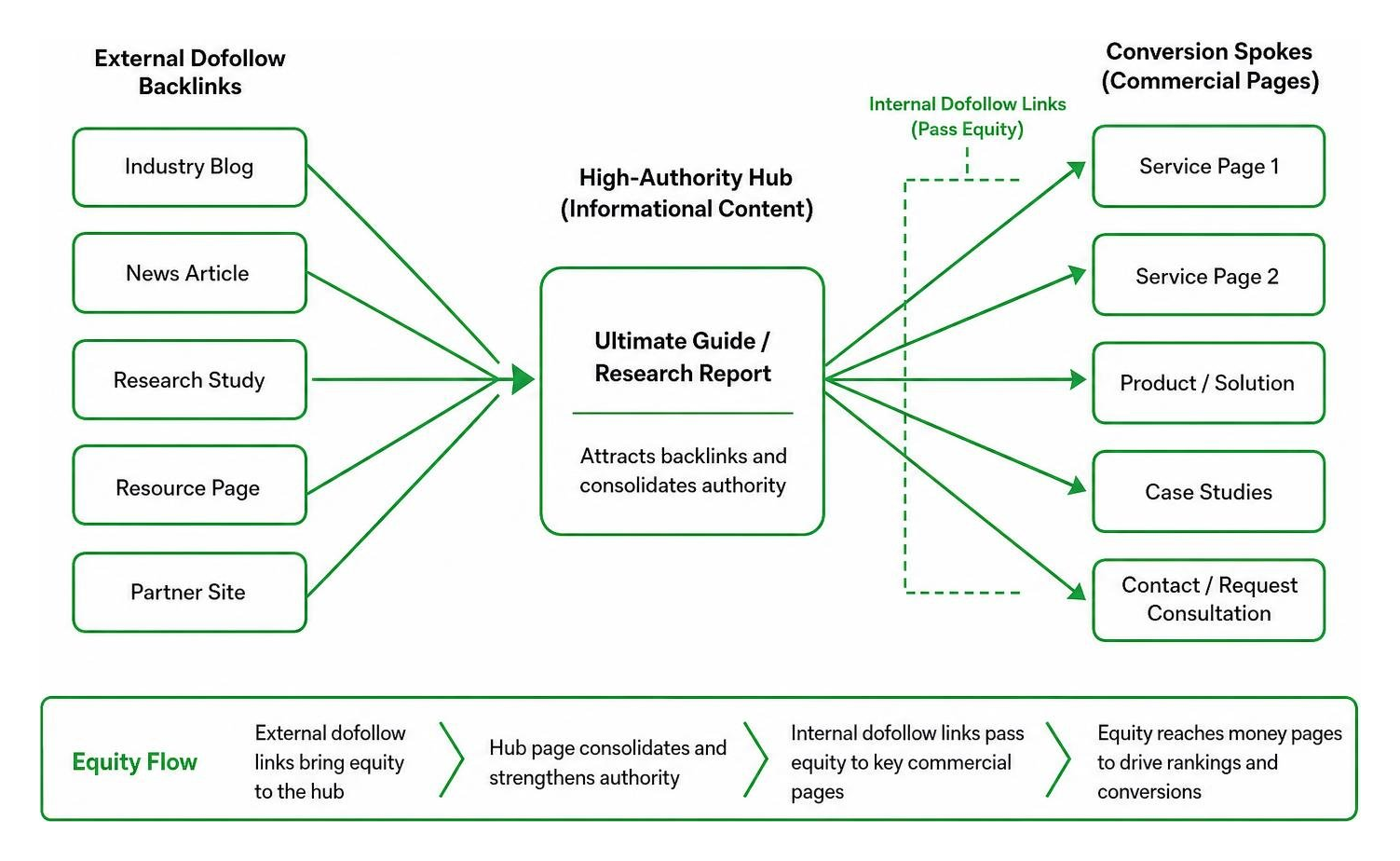
Once you fix authority leaks, use a Hub-and-Spoke Equity Map to distribute equity internally. Informational assets (like deep-dive guides or research reports) usually attract the majority of external dofollow seo backlinks. By placing contextual, internal dofollow links within those high-authority "hub" blog posts pointing directly to your primary "spoke" commercial pages, you pass earned link equity straight to your money pages.
For additional frameworks on framing your site's authority, read How a Strong Brand Story Can Differentiate You From Competitors and browse our digital marketing Resources. For deeper insights into modern link attribute guidelines, consult What Are Dofollow Backlinks? SEO Guide 2026.
Frequently Asked Questions About Dofollow Backlinks
What is the ideal ratio of dofollow to nofollow links?
There is no single "magic" ratio mandated by search engine algorithms. A healthy backlink profile typically ranges between 60%–80% dofollow links and 20%–40% nofollow, sponsored, or UGC links. Focus on securing links naturally from topically relevant sites rather than attempting to engineer an exact proportion.
Are nofollow backlinks completely worthless for ranking in 2026?
No. Since Google transitioned nofollow to a ranking "hint" in 2020, search engine crawlers may still use nofollow links for page discovery, topical mapping, and entity verification. Furthermore, high-authority nofollow links generate direct referral traffic, build brand equity, and frequently lead to organic dofollow citations from readers who discover your content.
What are the biggest mistakes to avoid when building dofollow links?
The most dangerous mistakes include:
- Buying cheap, automated bulk link packages from spammy directories.
- Over-optimizing anchor text with aggressive exact-match commercial keywords.
- Prioritizing domain authority metrics over topical relevance.
- Applying
rel="nofollow"to internal links on your own website.
To review additional technical considerations, consult NoFollow vs DoFollow Links: The Complete SEO Guide | Flyn.
Conclusion
At Agency Next, we believe off-page search engine optimization should be sustainable, strategic, and direct link equity toward real business results. Chasing low-quality backlink blasts or artificial link schemes can compromise your domain's health. Instead, focusing on high-value linkable assets, conducting thorough equity leak audits, and routing authority through clean internal architecture builds compounding organic visibility.
Whether you need to overhaul your off-page backlink strategy, modernize your web platform, or launch automated lead generation systems, our team in Waukesha, WI is here to elevate your brand. Explore Agency Next Services today to turn your website into a high-converting growth machine.
Featured Resources
Check Our Latest Resources