

Why a Keyword Ranking Service Matters for Local Growth
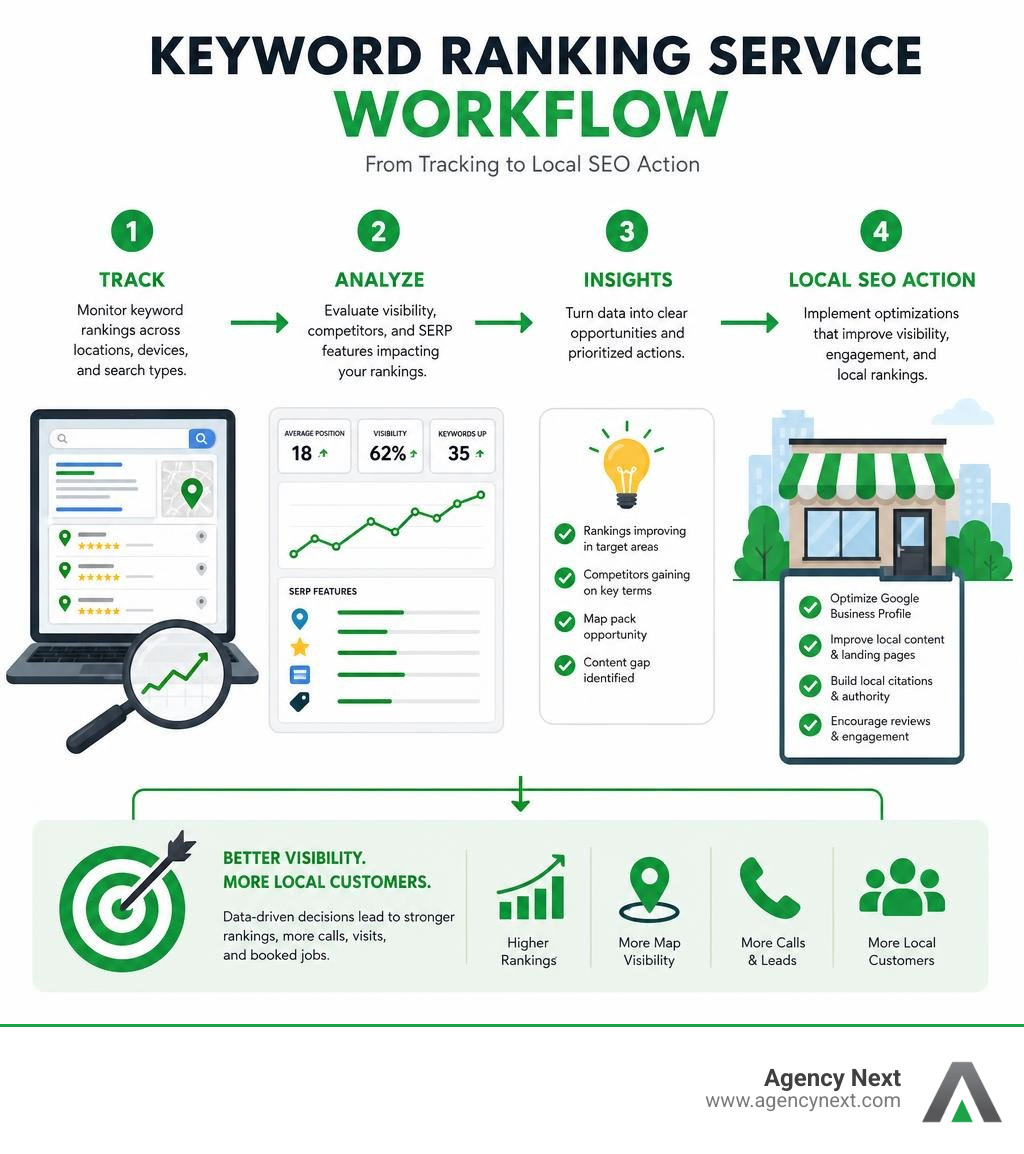
A keyword ranking service helps you see where your business appears in Google and other search results for the terms customers use, then turns that data into a clearer plan for improving visibility.
For a local plumber, landscaper, or other service business, this means more than checking whether you rank for "plumber near me." A useful service tracks rankings by city, device, and search result type, so you can tell whether people in your actual service area can find you in organic results, Google Maps, and the local 3-pack.
| What it does | Why it matters |
|---|---|
| Tracks keyword positions over time | Shows whether search visibility is improving or slipping |
| Uses location-specific, unpersonalized results | Avoids the misleading results caused by your own search history and location |
| Monitors competitors | Reveals the terms and pages bringing them visibility |
| Measures SERP features and visibility | Shows whether ads, maps, images, or AI results push your listing lower on the page |
Manual Google searches are not a reliable benchmark. Results can change based on your location, device, browser history, and the crowded features on the page. Modern rank tracking also looks beyond a simple "position 1" result, because a map pack, ads, featured snippet, or AI Overview may still place an organic listing far below the first screen.
I’m Koby Luedtke, co-founder of Agency Next, where I help local businesses improve search visibility through conversion-focused websites, SEO, video, and ad strategy. In this guide, I’ll explain how to assess a keyword ranking service and use its data to support practical local SEO decisions.
What Is a Keyword Ranking Service and How Does It Differ From Standard SEO Tools?
At its core, a keyword ranking service is a specialized solution—delivered either through managed professional expertise, dedicated rank checking software, or a hybrid of both—that systematically monitors, analyzes, and optimizes where your web pages appear on search engine results pages (SERPs). While many business owners assume that typing their favorite search terms into Google on a office desktop yields accurate results, manual tracking creates significant blind spots.
When you search manually, search engines utilize your IP address, browser cookies, past search history, physical proximity, and logged-in account settings to serve tailored, personalized results. This personal bias creates an illusion of high rankings that actual prospective customers in adjacent towns or target postal codes never see.
A dedicated keyword ranking service eliminates this bias by querying search engine APIs or utilizing unpersonalized, clean proxy networks across thousands of geographic locations. Instead of merely recording whether a domain appears on page one, a professional service assesses true organic position, local map pack placements, SERP feature occurrences, and historical movement over time. By scrubbing away local browser bias, you gain access to clean, objective baseline data that reflects how real searchers discover your brand. If you want to run quick, unpersonalized sanity checks on your primary queries, using a Free Keyword Rank Checker provides an instant snapshot of your baseline visibility before diving deeper into strategy.
Freelance vs Software: Choosing a Keyword Ranking Service
When evaluating how to execute rank tracking and keyword expansion, businesses generally choose between hiring freelance gig providers or subscribing to automated software platforms. Both options serve distinct roles in digital marketing strategies:
- Freelance Keyword Ranking Services: Independent specialists often offer targeted, project-based tasks. Common freelance offerings include specialized Keyword Golden Ratio (KGR) research for finding ultra-low competition terms, German or Finnish localized keyword lists, YouTube video optimization, Amazon Helium 10 research, parasite SEO setups, or setting up Google Autocomplete suggestions. Freelancers provide human ingenuity and custom labor, but their deliverables are typically static point-in-time reports rather than continuous monitoring.
- Dedicated Software Platforms: Automated rank trackers operate continuously, scanning target search engines daily or even hourly. Software platforms excel at long-term historical data aggregation, tracking thousands of terms across 185+ countries, firing immediate rank drop alerts, and feeding data directly into Business Intelligence dashboards via APIs.
For most growing businesses, software provides the underlying engine for daily rank tracking, while specialized human services interpret those data streams to execute technical improvements, content creation, and local link building.
Standard SEO Tools vs Dedicated Rank Checking
While broad all-in-one SEO suites include basic rank checking modules, enterprise-grade rank trackers offer far greater granularity. Standard SEO tools often update keyword positions weekly or monthly and rely on broad national averages.
In contrast, specialized rank tracking solutions deliver:
- Daily and Real-Time Data: Search algorithms shift continuously. Daily position updates catch sudden algorithmic updates or technical indexing errors immediately, rather than weeks after organic traffic drops.
- Full SERP Previews and Pixel Depth: Specialized rank checkers store HTML SERP snapshots, allowing you to visually verify where your link appeared relative to competitor ads, maps, and answer boxes.
- Geo-Targeted IP Infrastructure: Enterprise rank tracking routes queries through specific regional residential IPs down to exact zip codes or city coordinates, preventing artificial national averaging.
Understanding these technical distinctions helps you build a scalable measurement pipeline. To explore more about aligning rank tracking metrics with content frameworks, review our library of SEO Resources.
Main Types of Keyword Ranking Services and Tracking Capabilities
Modern search expands far beyond traditional desktop text queries on Google. A modern keyword ranking service tracks user discovery across search engines, mobile app stores, e-commerce marketplaces, and generative AI search engines.
App Store and E-Commerce Ranking Solutions
Search behavior extends directly into application ecosystems and e-commerce platforms. Industry data reveals that approximately 70% of mobile users discover new apps directly by searching store charts and search bars on the Apple App Store and Google Play Store. Yet, about 90% of published apps remain practically invisible due to poor keyword optimization and sub-optimal search velocity.
App Store Optimization (ASO) keyword ranking services rely on specialized mechanics:
- App Store & Google Play: Services focus on algorithmic signals including search keyword download velocity, direct install pushes, multi-day user engagement retention, and localized rating signals. Elevating an app from position 50 into the top 3 results for a competitive query can instantly transform acquisition metrics.
- Amazon & E-Commerce Marketplaces: Amazon keyword ranking relies heavily on organic sales conversions, click-through rates, and targeted backend search terms. Ranking services utilize specialized tools like Helium 10 to extract high-converting search volumes, structure sponsored PPC campaigns, and boost product listings into organic buy-box SERPs.
Multi-Platform and AI Search Tracking
As user search habits evolve, search discovery spans multiple discovery hubs simultaneously. A versatile keyword ranking service monitors search positions across:
- Generative AI Platforms & LLMs: Platforms like ChatGPT, Google Gemini, Claude, Perplexity, Grok, and DeepSeek increasingly act as primary search interfaces. Modern tools track brand mentions, source citations, and share of voice inside AI-generated responses.
- Google AI Overviews (SGE): Tracking whether your content is cited as a supporting link inside AI Overviews directly above traditional organic listings.
- YouTube Video Search: Video search engines index tags, closed captions, view duration, and regional search CTR to rank videos in both internal YouTube search and Google Video Carousels.
To evaluate platforms that measure visibility across traditional SERPs and generative AI engines, explore a specialized Rank Tracker for Search and AI.
Essential Metrics and Tracking for Organic vs Paid Campaigns
Evaluating ranking performance requires analyzing a complete set of SEO metrics. A standard position number (e.g., "Position 4") tells only a fraction of the story.
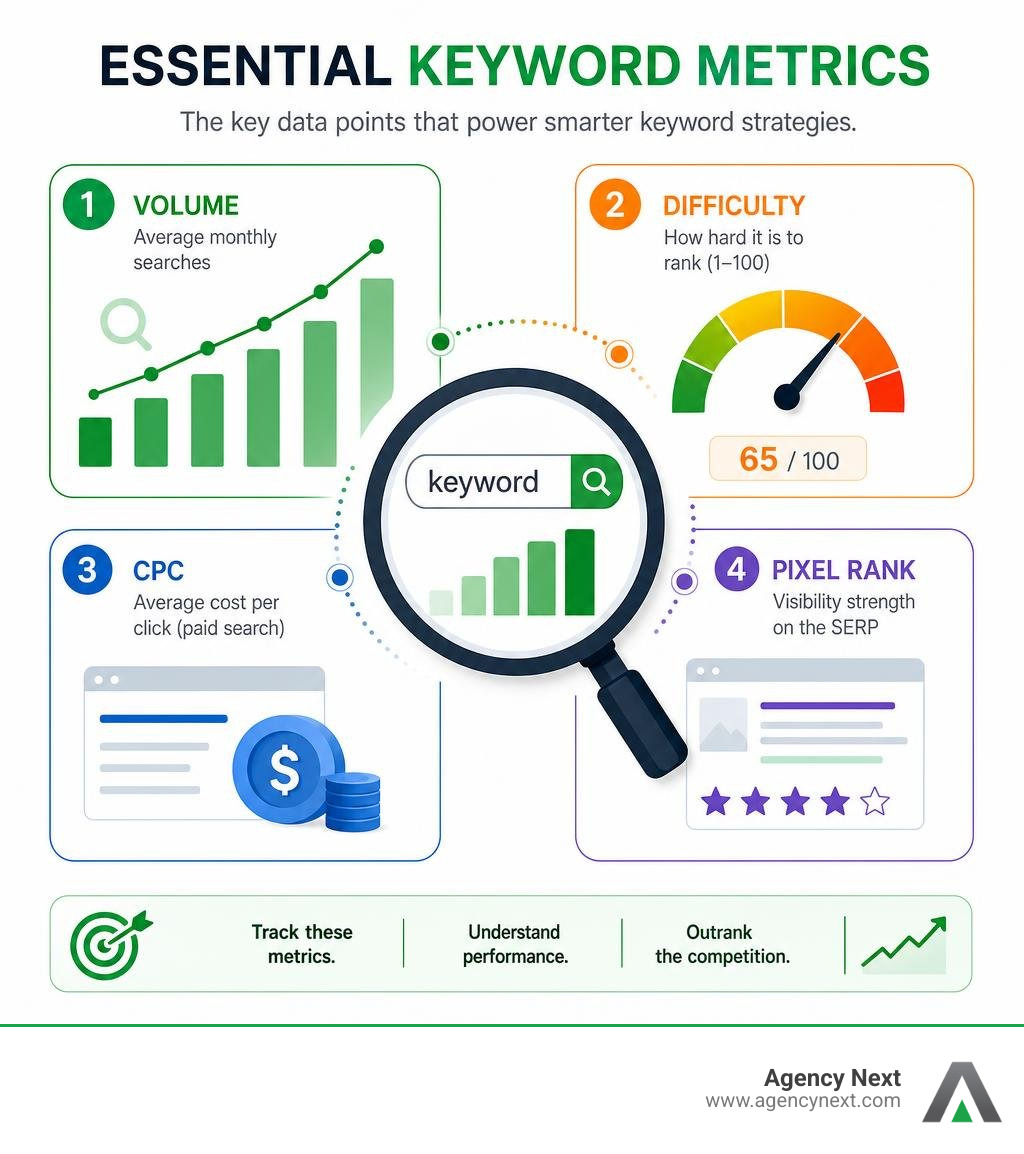
A comprehensive keyword ranking service measures at least five essential data points:
- Monthly Search Volume: The estimated number of times a specific keyword is queried within a selected geographic location each month.
- Keyword Difficulty (KD): A calculated score (typically 1–100) estimating how hard it is to rank on page one based on competitor domain trust, backlink authority, and content depth.
- Cost Per Click (CPC): The average advertising cost advertisers pay in Google Ads for a single click, serving as a direct indicator of commercial intent and conversion potential.
- Share of Visibility / Share of Voice: A calculated percentage indicating how much total available search traffic your domain captures for a tagged group of keywords relative to competitors.
- Pixel Depth / Pixel Rank: Measuring how many vertical pixels down the screen a user must scroll before seeing your organic link.
For those looking to analyze baseline metrics and monthly volume dynamics across localized search databases, try testing a Google Keyword Rank Checker.
Organic Rank Tracking vs Paid PPC Performance
A critical distinction when setting up rank monitoring is distinguishing between organic position tracking and paid PPC advertisement tracking.
- Organic Keyword Tracking: Measures non-paid search results determined by Google’s core ranking algorithms. Organic success builds long-term domain authority, delivers compound unpaid traffic over time, and requires continuous on-page, technical, and backlink maintenance.
- Paid (PPC) Performance: Tracks Google Ads placements, Google Shopping product carousels, and Sponsored Local Services Ads (LSAs). Paid tracking focuses on ad position, impression share, Quality Score, click-through rate (CTR), and direct cost-per-acquisition.
Combining organic and paid search data reveals strategic synergies. For instance, if an organic page reaches position 1 for a high-cost search term, you can strategically scale down paid ad spend on that keyword to reallocate budget toward underperforming queries. Review our real-world campaign case studies across paid and organic channels in our Digital Marketing Projects showcase.
SERP Feature Metrics and Pixel Ranking
Google search engine results pages are increasingly dense visual environments. Organic position 1 historically sits at the very top of the page. Today, however, a single search query might display two sponsored ads, an AI Overview snippet, a Local 3-Pack map, an Image Carousel, and a People Also Ask accordion before displaying the first standard organic link.
Because of this visual congestion, numerical position 1 no longer guarantees immediate user clicks. Enterprise ranking tools utilize Pixel Depth Tracking. Pixel ranking measures exact screen distance from the top of the browser viewport to your link. If your page holds organic position 1 but sits 1,200 pixels down the page below ads and maps, it resides "below the fold," requiring users to scroll manually. Tracking SERP feature ownership—such as winning featured snippets, image packs, or local map pins—is essential to capturing true visual visibility.
Local vs Global Geo-Targeting in SERP Performance
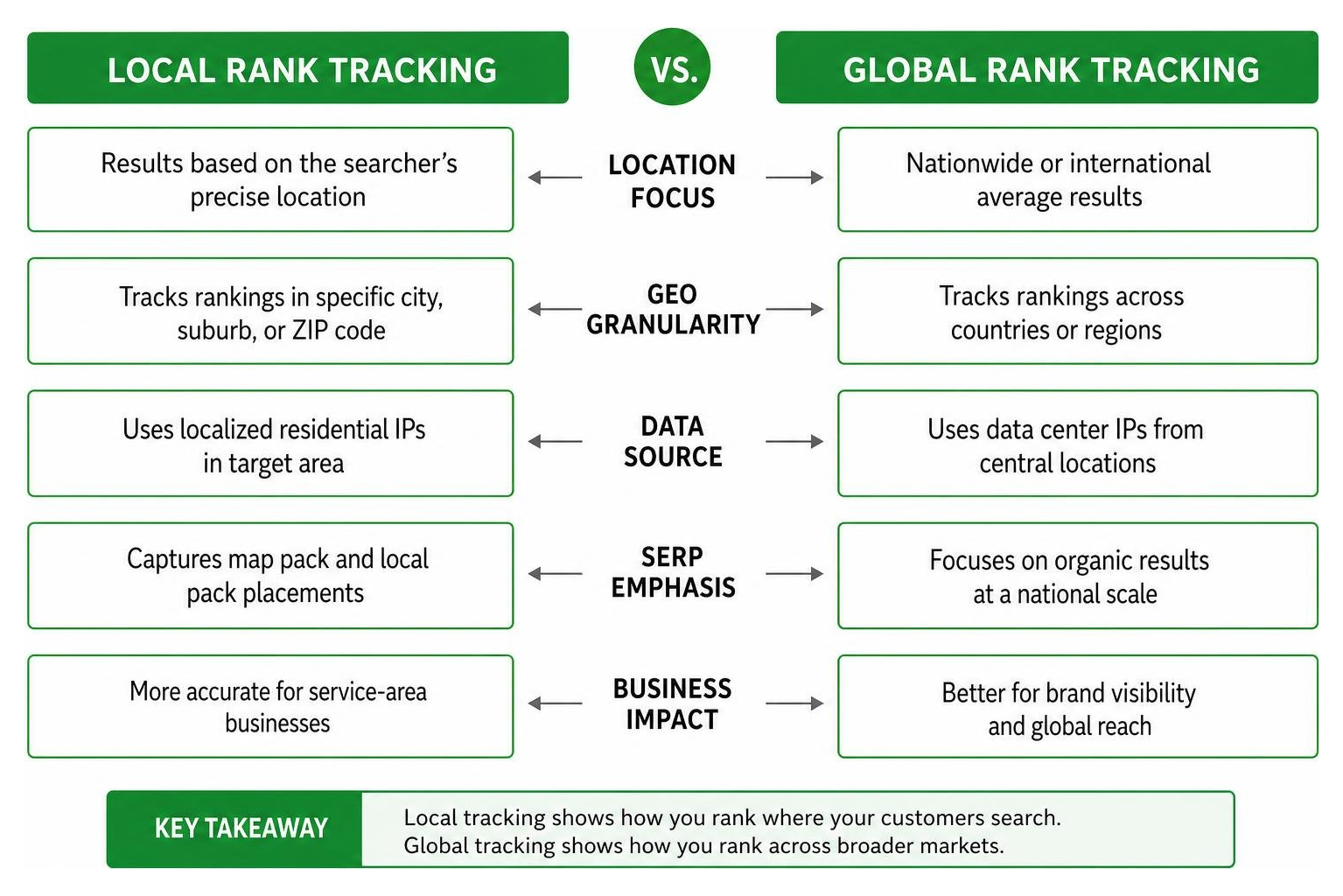
For service-based businesses, national search engine rankings are often meaningless. A commercial contractor in Waukesha, Wisconsin does not benefit from ranking #1 in Dallas, Texas. Search engines heavily adapt results based on the searcher's precise physical location.
The Importance of Hyper-Local IP Tracking
When local consumers search for service providers, Google prioritizes proximity, Google Business Profile (GBP) signals, local citation matching, and review velocity. Standard rank checkers that query Google from central data centers return generic national averages. A true hyper-local keyword ranking service routes data through localized residential proxy networks down to specific cities, suburban sub-markets, or zip codes.
| Tracking Parameter | Global / National Rank Tracking | Hyper-Local Rank Tracking |
|---|---|---|
| Location Accuracy | Country-level average (e.g., United States) | City, suburban neighborhood, or ZIP code level |
| Search Engine Engine | Standard Organic Web Index | Google Local 3-Pack, Google Maps, Mobile SERP |
| Primary Data Source | National SERP scrapers | Local IP proxies & GPS coordinate simulation |
| Primary Business Goal | Enterprise SaaS, National E-Commerce, Digital Media | Service area businesses, physical retail, medical practices |
| Algorithmic Drivers | Domain Authority, Backlinks, Global Content Depth | Proximity, GBP Optimization, Local Citations, Reviews |
Hyper-local tracking allows a multi-location business to observe how their Google Maps ranking changes as a user moves five miles across town, enabling precise local link-building and geo-targeted optimization.
Mobile vs Desktop Ranking Variance
Search engines operate under strict mobile-first indexing, meaning Google evaluates the mobile version of your content to determine search rankings. Furthermore, user search behavior and SERP layouts differ dramatically between mobile phones and desktop computers.

Mobile search results feature:
- Compressed screen real estate that emphasizes map packs and click-to-call buttons.
- Frequent insertion of localized "near me" prompts based on live smartphone GPS coordinates.
- Continuous infinite-scroll mechanics that change organic click-through distributions.
Tracking mobile and desktop rankings separately is critical. A desktop page ranking in position 3 might drop to position 8 on mobile if mobile page speed or responsive layout issues trigger algorithmic penalties.
Evaluating Competitors and Selecting the Right SEO Strategy
Data collection is only valuable when tied to strategic execution. A professional keyword ranking service converts SERP positional tracking into competitive intelligence.
Leveraging Competitor Keyword Analysis for Strategy
Monitoring your direct search competitors provides a strategic roadmap for organic expansion. By systematically scraping competitor rankings across shared industry keyword sets, you can execute:
- Keyword Gap Analysis: Uncovering high-volume queries where direct competitors rank in the top 5, but your website lacks indexed landing pages.
- SERP Competitor Trust Benchmarking: Comparing competitor Domain Trust, Page Trust, and referring backlink profiles against your own to calculate real-world ranking feasibility.
- Content Depth & Search Intent Matching: Evaluating why competitor URLs win featured snippets by reviewing their heading structure, schema markup, and content formatting.
When you spot a competitor ascending rapid rank positions for profitable search terms, analyzing their recent page updates or backlink acquisitions allows you to counter with superior targeted content and stronger local authority.
Risks and Reality of Guaranteed Keyword Ranking Service Packages
When shopping for an external keyword ranking service, you will inevitably encounter vendors marketing "Guaranteed #1 Page Ranking Packages" promising instant top 3 positions within 30 days or money-back guarantees.

While these offers sound attractive, business owners must approach ranking guarantees with extreme caution. Search engines explicitly warn against third-party providers offering rank guarantees, as search engine algorithms evaluate hundreds of dynamic factors that no external entity directly controls.
Risky tactics frequently employed by unethical guaranteed ranking services include:
- Targeting Zero-Volume Keywords: Vendors deliver on their guarantee by ranking your site for obscure, long-tail phrases that no real prospective customer ever searches for.
- Parasite SEO & Spam Backlink Injection: Building low-quality, automated backlink blasts or renting temporary links on questionable third-party domains. While this can trigger temporary rank spikes, it frequently leads to severe manual penalties or complete site de-indexing by search engine spam filters.
- Incentivized Install Manipulation: In app stores, purchasing inorganic download pushes that trigger artificial ranking boosts followed by immediate algorithmic drops once the campaign ends.
Sustainable, white-hat keyword ranking strategies focus on technical foundation, authoritative content creation, real local trust signals, and progressive authority building. To learn how we build conversion-focused digital frameworks backed by transparent SEO practices, explore our comprehensive SEO Services.
Frequently Asked Questions About Keyword Ranking Services
What is the difference between a keyword ranking service and an automated rank checking tool?
An automated rank checking tool is a software utility that periodically pings search engine result pages to log positional data. A keyword ranking service encompasses both the tracking technology and the strategic, human-driven execution required to improve those positions. Services analyze ranking fluctuations, conduct technical on-page audits, optimize content, build local citations, and adjust marketing strategies based on tracking intelligence.
Why do keyword rankings vary between local and global search results?
Google personalizes search results based on physical proximity, IP addresses, search history, and device parameters. Local search queries emphasize proximity signals, Google Business Profile rankings, and local map pack listings. Global search results prioritize broad domain authority, sitewide backlink profiles, and comprehensive content depth without geographic bias.
How are AI platforms like ChatGPT and Gemini tracked by modern ranking services?
Modern rank tracking platforms track AI visibility by executing automated prompts across LLM engines like ChatGPT, Gemini, Perplexity, and Claude. These platforms monitor brand name mentions, website domain URL citations, share of voice within AI answers, and inclusion inside Google AI Overviews (SGE) blocks.
Conclusion
Mastering search engine visibility requires moving beyond manual Google lookups and basic position numbers. A modern keyword ranking service gives your business clear visibility across local map packs, desktop and mobile SERPs, e-commerce platforms, and emerging AI search engines. By tracking hyper-local positions, visual pixel depth, and competitor movements, you convert raw rank data into strategic, revenue-generating local SEO decisions.
At Agency Next, we partner with service businesses and brands to transform search rankings into high-converting web experiences. To discover how our team can engineer your search strategy and local visibility, explore our conversion-driven SEO Services today.
Featured Resources
Check Our Latest Resources