

Why Keyword Competitor Analysis Gives Local Businesses an SEO Edge
Keyword competitor analysis is the process of finding the Google searches your competitors rank for, then deciding which of those searches your business can realistically win. For a local service business, it reveals the service pages, location terms, and customer questions that may be bringing leads to competing sites instead of yours.
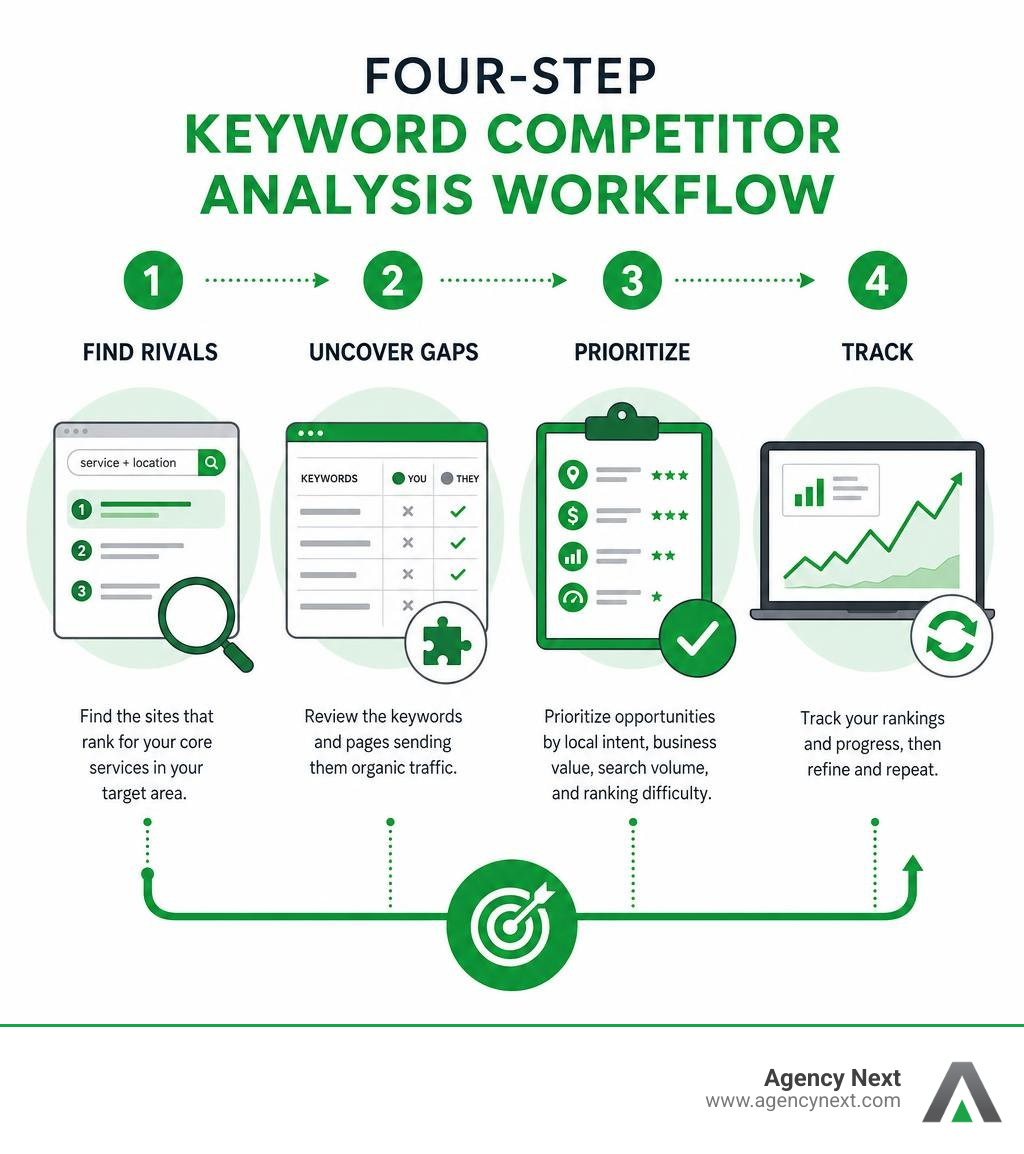
A quick process looks like this:
- Find the sites that rank for your core services in your target area.
- Review the keywords and pages sending them organic traffic.
- Identify gaps: relevant terms they rank for that your site does not.
- Prioritize opportunities by local intent, business value, search volume, and ranking difficulty.
This is not about copying every keyword a rival targets. It is about using real search results to see what local customers want, where competitors have weak content, and how your website can provide a clearer, more useful answer. Search results can change by city and region, so local SEO research matters as much as the keyword itself.
I am Koby Luedtke, Co-Founder of Agency Next, where I help local businesses improve visibility with conversion-focused websites, SEO, and digital strategy. My work in keyword competitor analysis focuses on turning competitor data into practical content and lead-generation opportunities, not vanity rankings.
Fundamentals of Keyword Competitor Analysis
At its core, keyword competitor analysis provides a clear roadmap for improving your organic search rankings by analyzing what already works in your marketplace. Rather than guessing which terms your prospective customers use, you evaluate real-world performance data from domains competing for the exact same audience.
When conducting this research, we begin with seed keywords—the primary search terms that define your products, services, and core operations. By entering seed queries or your domain into a specialized Keyword Gap Analysis Tool, you can perform a direct domain comparison. This process parses millions of ranking data points to isolate overlap and pinpoint exact queries where your rivals capture search traffic while your domain remains invisible.
Understanding user search intent is critical throughout this foundational stage. Search queries generally fall into distinct classifications:
- Informational: Users seeking answers, tutorials, or educational insights (e.g., "how to fix a leaky faucet").
- Commercial: Searchers evaluating options and comparing service providers (e.g., "best plumbing services near me").
- Transactional: High-intent users ready to purchase or book immediately (e.g., "emergency plumber Waukesha quote").
- Navigational: Users looking for a specific brand or login portal.
By matching seed keywords to intentional audience queries, you establish a solid framework for capturing qualified web traffic.
How to Identify True SEO Competitors
Your direct business competitors are not always your primary organic search rivals. A local storefront down the street might compete for your local foot traffic, but in search engine results pages (SERPs), your primary SEO rivals could include national directories, industry publications, or aggressive regional competitors.
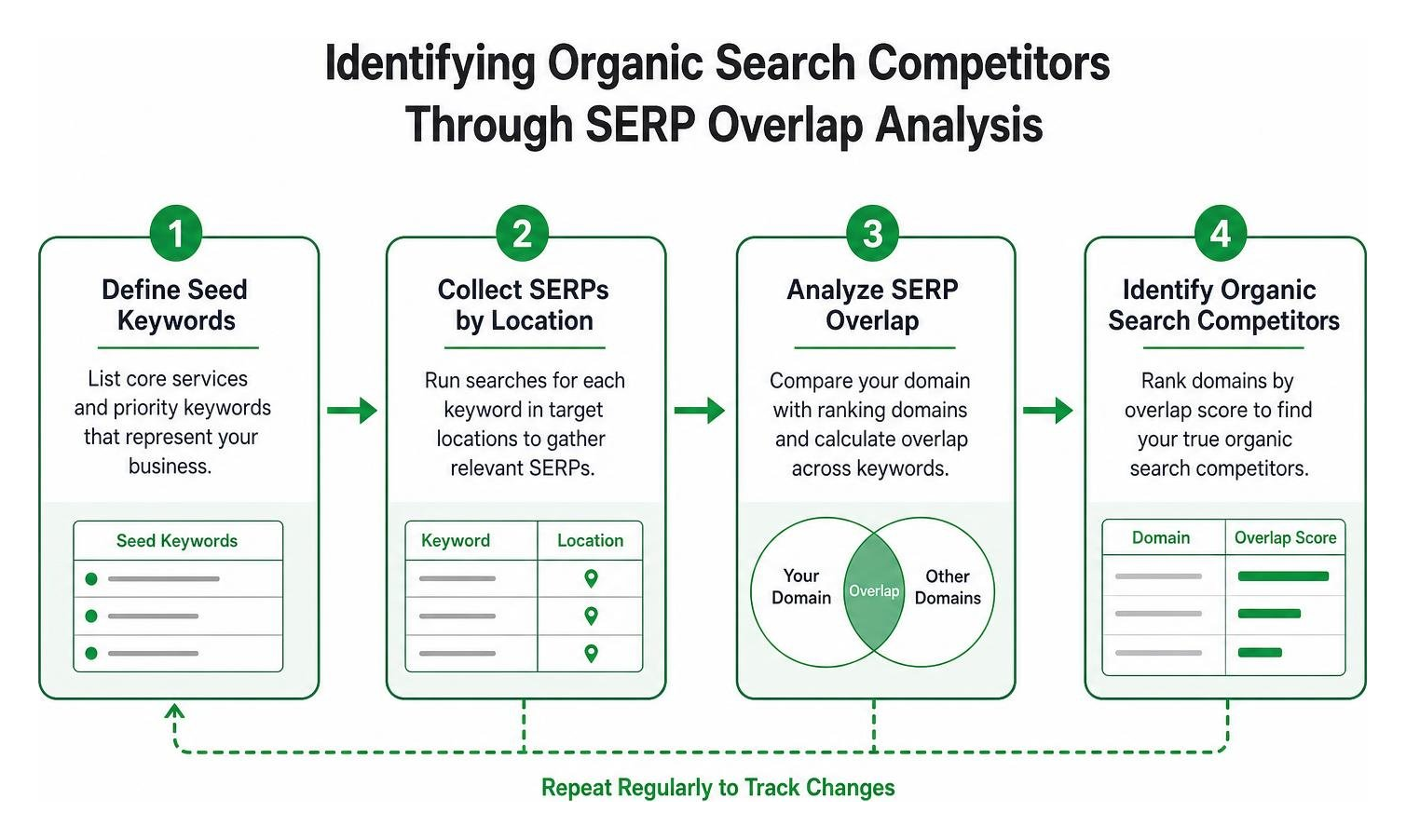
To identify true organic rivals, focus on domain trust and SERP overlap. SERP overlap measures how frequently another website appears alongside your site for your core list of service keywords. To locate your genuine search engine competitors:
- Perform Seed Query Searches: Run manual or automated lookups for your primary services within your exact service radius.
- Evaluate Local SERPs: Search engine results vary significantly by geographic location. With over 50,000 local SERP locations available in modern SEO tools, evaluating localized rankings ensures you analyze rivals who actually rank in your target city.
- Filter Out Aggregator Noise: Separate actual service providers from broad directory aggregators (like Yelp or YellowPages) so you can benchmark your site against realistic business peers.
Key Metrics to Evaluate in Keyword Competitor Analysis
To determine which search terms offer the highest return on investment, we evaluate specific metrics provided by industry tools. Relying on raw search numbers alone can lead to wasted budget and misaligned content efforts. Instead, evaluate the full spectrum of data points to uncover actionable SEO Competitor Analysis Insights.
Key performance metrics to review include:
- Search Volume: The estimated monthly search frequency for a query within a specific geographic location. That search volume fluctuates regionally; a term with 1,000 monthly searches nationally might only generate 50 monthly searches in your local market, yet those 50 searches could represent high-value leads.
- Keyword Difficulty (KD): An estimated index (usually scored from 1 to 100) indicating how hard it is to displace top-ranking SERP competitors. Newer sites typically aim for lower KD ranges (1–40), whereas established domains with strong backlink profiles can effectively target KD ranges of 50–70.
- Cost Per Click (CPC): Estimated advertising costs in Google Ads. Higher CPC rates often indicate high commercial conversion rates, showing that competitors are willing to pay top dollar for that traffic.
- Search Intent Match: Whether the top-ranking URLs display landing pages, long-form blog guides, video embeds, or e-commerce store categories.
Understanding Keyword Gap vs Content Gap
While marketers frequently use the terms interchangeably, there is a fundamental difference between a keyword gap and a content gap in SEO strategy.
A keyword gap refers to specific search queries that your competitors rank for in search results, but your domain does not. For instance, if a competitor ranks on page one for "tankless water heater installation" and your site has no ranking position for that explicit keyphrase, you have identified a clear keyword gap.
A content gap, on the other hand, represents broader unaddressed topics or entire structural pages missing from your digital footprint. If competitors feature full subtopic clusters detailing seasonal maintenance, pricing breakdowns, and equipment care guides that your site completely lacks, you face a strategic content gap. Addressing content gaps requires creating comprehensive page architecture rather than simply inserting missing search phrases into existing body copy.
When evaluating these gaps, advanced research software lets you switch between domain mode (comparing overall domain profiles to uncover macro-level topic missing pieces) and webpage comparison mode (comparing two specific URLs head-to-head to fine-tune structural on-page elements). Exploring our curated Marketing Resources can help deepen your understanding of structural content planning.
How to Execute a Step-by-Step Keyword Competitor Analysis
Executing a streamlined analysis requires a structured approach to raw data processing. Utilizing a specialized Competitor Keywords Discovery Tool lets you quickly extract search terms driving organic traffic to competitor pages.
Follow this practical workflow:
- Data Extraction: Input your baseline domain alongside 3 to 5 primary organic search competitors into your preferred software.
- Identify Keyword Overlap: Examine shared terms where both your site and competitor domains rank simultaneously. Note ranking position differences.
- Isolate Missing Keywords: Filter results to show terms where competitors hold top 10 SERP rankings, but your domain ranks outside the top 50 or lacks indexing completely.
- Apply Strategic Filtering Techniques: Filter out irrelevant search terms, extreme outliers, or unserviceable geographic regions. Sort the remaining target terms by intent, search volume, and difficulty.
Assessing Keyword Difficulty and Ranking Feasibility
Discovering a high-volume keyword competitor gap is exciting, but you must evaluate your site's realistic ranking feasibility before creating content. Outranking established SERP leaders requires evaluating both domain-level and page-level strength metrics.
When conducting a feasibility audit, evaluate:
- Backlink Profile Quality: Analyze the quantity, authority, and diversity of referring domains pointing to competitor pages. Pay close attention to dofollow links versus nofollow attributes, as dofollow backlinks directly pass ranking authority. A competitor page with fewer high-relevance, dofollow links is significantly easier to surpass than one with hundreds of artificial links.
- Domain Trust and Authority: Evaluate the baseline trust score of the ranking sites. If the top five SERP positions are dominated by ultra-high authority domains, building topic clusters and securing targeted backlinks will be necessary to compete.
- Landing Page Structure: Examine competitor layout, structural heading hierarchy (H1, H2, H3 tags), call-to-action placement, and page loading speeds. If competitor pages suffer from slow loading times or weak user experience, superior content design can give you a decisive edge.
Turning Competitive Research into High-Converting Content Strategies
Collecting raw search data is only valuable if you translate it into a structured, conversion-driven content strategy. Ranking at the top of search results generates vanity visibility unless those visitors convert into paying clients.
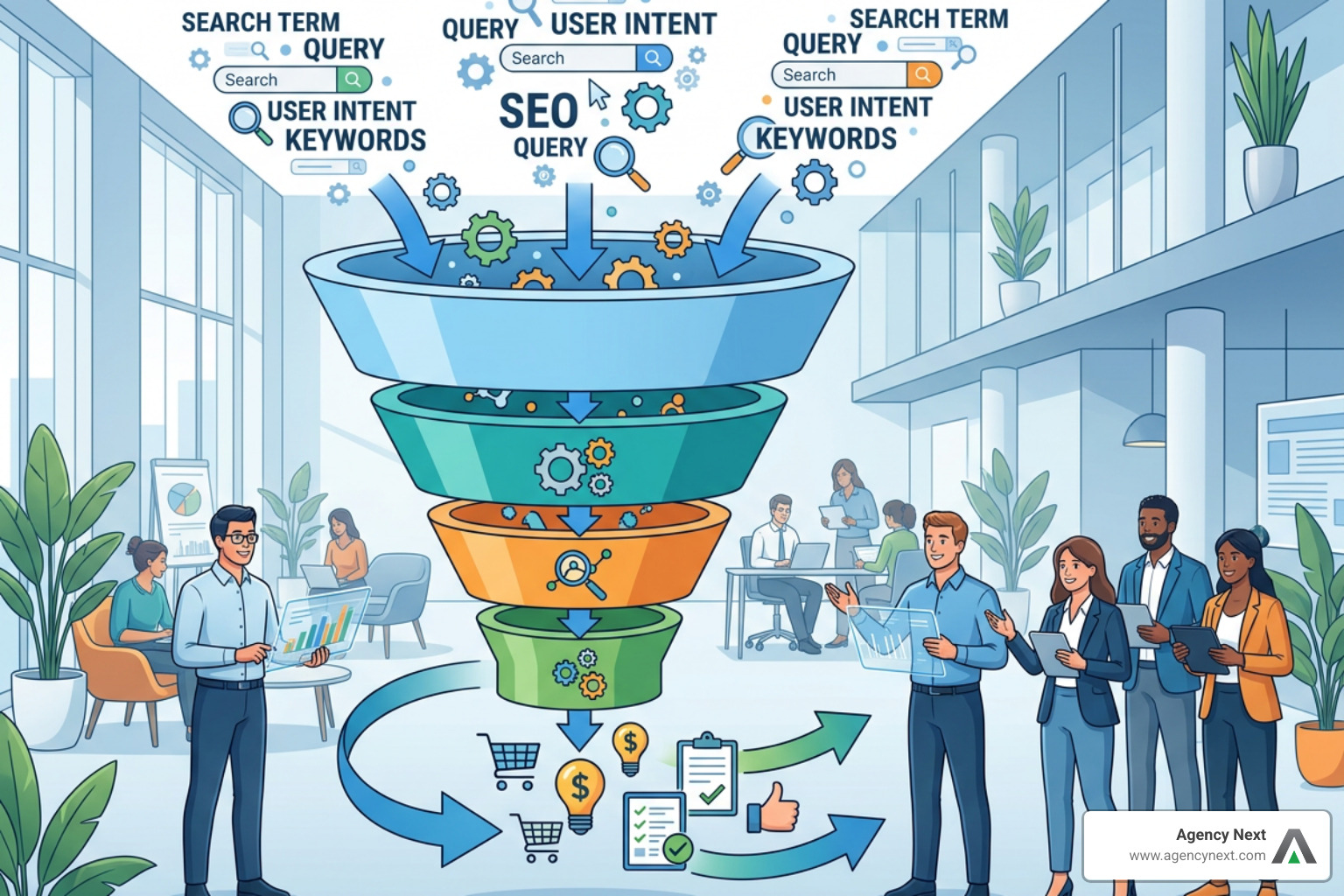
To turn research into results, organize identified keyword gaps into logical topic clusters. A topic cluster consists of a core pillar page covering a broad topic linked to subtopic pages addressing specific long-tail queries. This layout demonstrates comprehensive topical authority to search engine crawlers while guiding prospects smoothly through your sales funnel. Implementing effective site architecture is essential; explore our guide on Tips for Creating an SMB Website That Actually Converts to optimize your pages for prospective clients.
Prioritizing Competitor Keywords by Intent and Commercial Value
Not every keyword gap deserves immediate content creation. To maximize your return on effort, implement a structured business value scoring system (using a 0–3 rating scale) to prioritize opportunities based on commercial conversion potential:
| Value Score | Intent Category | Strategic Definition | Example Search Query |
|---|---|---|---|
| Score 3 | High Commercial / Transactional | Direct buying intent; high conversion likelihood for core services. | "hire commercial HVAC contractor Waukesha" |
| Score 2 | Commercial Investigation | Users actively comparing solution providers or evaluating costs. | "cost comparison tankless vs traditional water heater" |
| Score 1 | Informational | Broad audience research; lower immediate conversion potential. | "why is my AC blowing warm air" |
| Score 0 | Low Relevance | Negligible business value or unserviceable audience queries. | "history of air conditioning units" |
Focusing initial content development on Score 3 and Score 2 keywords ensures rapid lead-generation wins. Combine this intent scoring with your brand's unique selling proposition to differentiate your business; learn more about how a Strong Brand Story Can Differentiate You From Competitors.
Leveraging Keyword Competitor Analysis Data to Build Superior Content
Once you select high-priority search terms, perform a deep content audit on the top-ranking competitor landing pages to build superior assets. Your goal is to satisfy user search intent more thoroughly than existing SERP results.
During your audit, evaluate:
- On-Page Heading Architecture: Document the structural H1, H2, and H3 headers used on top-ranking competitor pages. Identify subtopics or common customer questions they failed to answer.
- Page Content Depth and Media: Check if top pages feature helpful visual assets, embedded video walkthroughs, downloadable checklists, or interactive calculators.
- PPC Ad Strategy Cross-Referencing: Review competitor paid search campaigns via PPC AdWords Strategy Analysis to see which headlines and value propositions rivals bid real ad budget on. Paid ad copy frequently highlights messaging angles that resonate with target customers.
- Preventing Keyword Cannibalization: Ensure your newly mapped target keywords are assigned to distinct pages. Keyword cannibalization occurs when multiple pages on your own website compete for identical target queries, diluting overall organic authority and confusing search engines.
Monitoring Competitor Keyword Rankings Over Time
Conducting a keyword competitor analysis is not a one-time project. Organic search results remain dynamic as search engines update algorithms and competitors refine their digital marketing strategies. Ongoing rank tracking keeps your business ahead of market shifts.

Establishing a 30-day lookback tracking window allows you to monitor search visibility fluctuations, spot emerging local rivals, and track competitor content updates. Categorize competitor positional movements into practical tracking buckets:
- Winners: Competitor pages rapidly gaining search positions or capturing new featured snippets.
- Losers: Competitor pages dropping in rank due to outdated content, decaying backlink profiles, or technical errors.
- Threats: Newly indexed competitor pages rising fast in search rankings for your highest-value commercial keywords.
Furthermore, search engine results pages vary based on user device types. Mobile search results place a heavy emphasis on localized map packs and physical proximity, whereas desktop SERPs often present expanded organic listings and side-bar extensions.
| Feature / Metric | Desktop SERP Characteristics | Mobile SERP Characteristics |
|---|---|---|
| Primary Visual Focus | Broad horizontal layouts, rich snippets, side panels | Local map packs, click-to-call buttons, visual thumbnails |
| Local Ranking Impact | Moderate geographic reliance based on IP address | Extreme proximity sensitivity based on real-time device GPS |
| User Search Behavior | In-depth research, long-form content consumption | Fast transactional actions, immediate phone calls, navigation |
| CTR Distribution | Distributed across top 5 organic results | Heavily concentrated on the top 2 organic slots and local map pack |
Frequently Asked Questions About SEO Competitor Analysis
What is the difference between a keyword gap and a content gap?
A keyword gap refers to specific, individual search queries that competitors rank for while your website does not. A content gap represents broader missing subtopics, entire service categories, or structural page types missing from your site architecture. Addressing keyword gaps involves optimizing existing pages or adding target phrases, whereas closing content gaps requires building comprehensive new pages or topic clusters.
How do you track and monitor competitor rankings over time?
Competitor rankings are monitored using rank tracking software that checks search positions across target geographic locations. By setting up automated tracking dashboards, you can monitor weekly or daily SERP position updates, track overall search engine visibility, and receive alerts when rivals launch new pages targeting your core keywords.
How many SEO competitors should you analyze at once?
For most local and mid-sized businesses, analyzing 3 to 5 direct SEO competitors provides the ideal balance of strategic depth and actionable clarity. Analyzing fewer than 3 sites may cause you to miss key search queries, while comparing more than 10 sites simultaneously can lead to data overload. Specialized software tools support comparisons across 3 to 10 domains at once.
Conclusion
Outsmarting your market rivals in organic search does not require guessing games or unproven marketing tactics. By executing a structured keyword competitor analysis, you transform real-world competitor performance data into a strategic roadmap for growth. Uncovering keyword gaps, evaluating commercial search intent, and creating superior content assets enables your business to systematically capture market share, increase search engine visibility, and turn website traffic into sustained revenue.
At Agency Next, we build custom digital marketing strategies, conversion-focused web architecture, and search campaigns that turn online visibility into tangible business growth. If you are ready to expand your reach and outrank your rivals, Explore Agency Next Digital Marketing Services to schedule a strategy session with our expert team today.
Featured Resources
Check Our Latest Resources